Was Gallatin County’s Form of Government Changed Without a Vote? (Part 3)
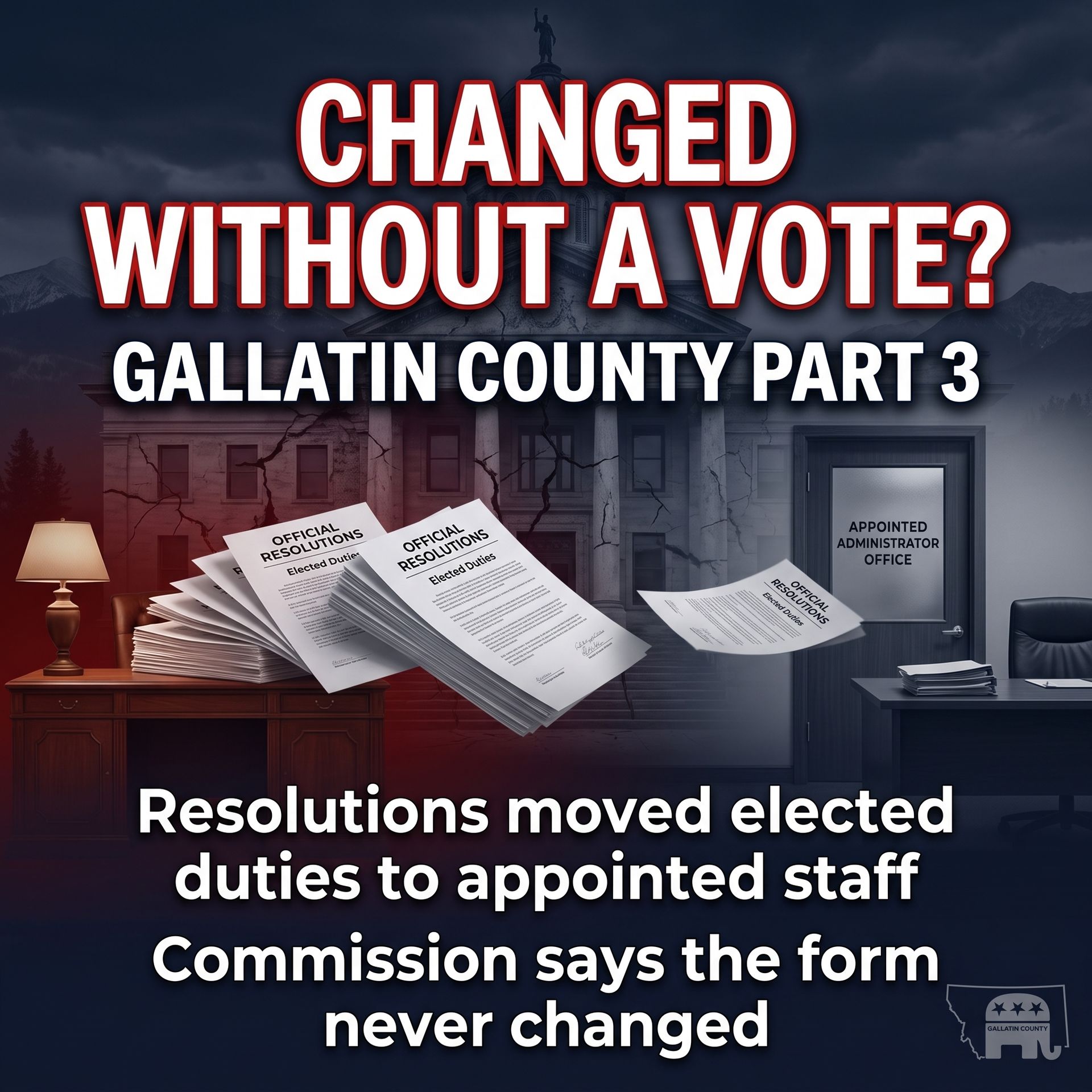
Resolutions moved statutory duties away from elected officials and into appointed staff. The Commission says the form never changed because voters never approved a new label.
In Parts 1 and 2 we documented the audit failures: two Disclaimers of Opinion, High-Risk Auditee status, an $8.5 million over-taxation error, and a cash reconciliation problem that has lasted for years.
Those problems did not happen in a vacuum. They happened while the Commission used resolutions to move core duties away from independently elected officials and into departments that answer to the Commission.
Montana counties operating under the default “elected county officials” form have general powers. That means the county can do what state law authorizes or reasonably implies. Changing the legal form of government requires a vote of the people.
What the Study Commission said
In its draft supplemental report, the Study Commission put the issue in plain language. The Accountability section, attributed to Commissioner White, stated:
“Gallatin County is an Elected County Official Form (ECOF) of government. With the official resolution assigning oversight of 23 county departments to the County Administrator’s office, it has migrated to a ‘Manager Form’ of government.”
That is the heart of the dispute. One side says the structure on the ground has already changed. The other side says it has not changed because no one held a referendum.
What the Commission said on July 24
On July 24, 2026, the County issued its official response to that report. The letter asked the Study Commission to delete the “Manager Form” language. It argued that using that phrase would leave the public with “the inaccurate impression that Gallatin County’s legal form of government has already changed — without any vote, and without any of the process the Montana Constitution requires for such a change.”
The Commission’s core claim was this:
“In other words, a county doesn’t drift or migrate from one form to another through internal reorganization. It adopts a different form only through the formal referendum process described in these statutes.”
And this:
“Gallatin County has not held a vote to adopt the county manager form. No plan of government under 7-3-105, MCA has been proposed, reviewed, or approved by voters. Gallatin County remains, as a matter of law, an Elected County Official Form government today.”
The letter also claimed:
“Nothing in the 2025 resolution altered the legal authority of the Board of County Commissioners or any independently elected official.”
And:
“The Treasurer, Clerk and Recorder, Sheriff, Superintendent of Schools, and other independently elected officials continue to hold the same constitutional and statutory authority they held before the 2016 and 2025 resolutions. Their offices were not restructured, absorbed, or placed under the Administrator’s authority by that resolution.”
Readers should notice the narrow wording. The letter is defending the County Administrator resolutions. It does not address the separate Treasurer resolutions that moved bank control.
What actually happened by resolution
County Administrator
The Commission created a County Administrator and later assigned oversight of 23 county departments to that office. The July 24 letter admits this was done by resolution, not by a vote of the people. The Commission’s defense is that the Administrator can be undone by another Commission vote, so it is only “an administrative choice,” not a change in form.
May 4, 2021 — Resolution 2021-050
Then-Treasurer Jennifer Blossom introduced a resolution delegating major treasury duties to the Commission and Finance Department. It passed unanimously. Duties assigned by statute to the elected Treasurer were placed under the Commission’s finance operation.
January 2024 — Resolution 2024-004
Newly elected Treasurer Maureen Horton refused to accept that arrangement. She argued an elected official’s statutory duties cannot be transferred without her consent. The Commission then passed Resolution 2024-004.
That resolution returned some operational treasury duties to Horton. It also kept the most important control with the Commission: sole authority to appoint and revoke bank signatories. The named signatories were the CFO and Accounting Manager. Treasurer Horton was not named.
Horton’s attorneys argued the resolution violated Montana law. The dispute has not been decided in court.
December 2025 — Election Department
The Commission later approved creating an appointed Election Administrator and a separate Election Department, effective after Clerk and Recorder Eric Semerad’s term ends on December 31, 2026. Election duties that have belonged to the elected Clerk and Recorder will move under Commission-appointed management.
MCA 13-1-301 (last amended in 2025) does allow a county to appoint an election administrator. The larger issue is the pattern: functions voters associate with elected offices keep moving under appointed staff. Previously, if the citizens were not pleased with the job being performed running the elections, they could directly vote out the elected official in charge of elections. Now, that will be nearly impossible as the appointed elections administrator will be supervised by 3 county commissioners who are elected on rotating terms.
Why the Commission’s argument does not settle the question
The Commission is technically correct on one point. Montana law treats “county manager government” as a specific legal form. That form is adopted only by a vote under Title 7, Chapter 3, MCA. Gallatin County has not held that vote.
That is not the whole story.
If a county assigns oversight of 23 departments to an unelected administrator, moves treasury bank authority to appointed finance staff, and prepares to take election administration out of the elected Clerk and Recorder’s office, the public is not required to wait for a new official label before asking what changed.
The County’s own Local Government Study Commission majority recommended keeping the elected-officials form. The majority warned that concentrating authority in a small number of commissioners and their appointees is exactly what the default model is designed to prevent.
Resolutions are not a substitute for that vote.
Why this belongs in the same series
The financial failures and the governance changes are connected.
When monthly reconciliations required by the county’s own accounting manual were skipped for years, the people closest to the cash were no longer operating under the statutory structure voters elected. Bank signatory authority sat with appointed finance staff. The Treasurer who wanted those duties back still does not control the accounts. Election administration is next.
Part 1 showed auditors could not certify the books.
Part 2 showed the $8.5 million error and the “Ongoing” corrective plans.
Part 3 shows how the Commission used resolutions to move power and then argued the form of government never changed because no one officially declared it changed.
This is Part 3 in our series on Gallatin County’s financial and governance problems. Part 4 will look specifically at the Election Department resolution and what it means when voters no longer elect the official who runs elections.
Read Part 1: Gallatin County Receives Second Disclaimer of Opinion in Five Years
Read Part 2: Gallatin County’s Financial Crisis Deepens