Gallatin County’s Financial Crisis Deepens (Part 2)
High-Risk Auditee status, $8.5 million over-taxation, and unanswered questions about accountability
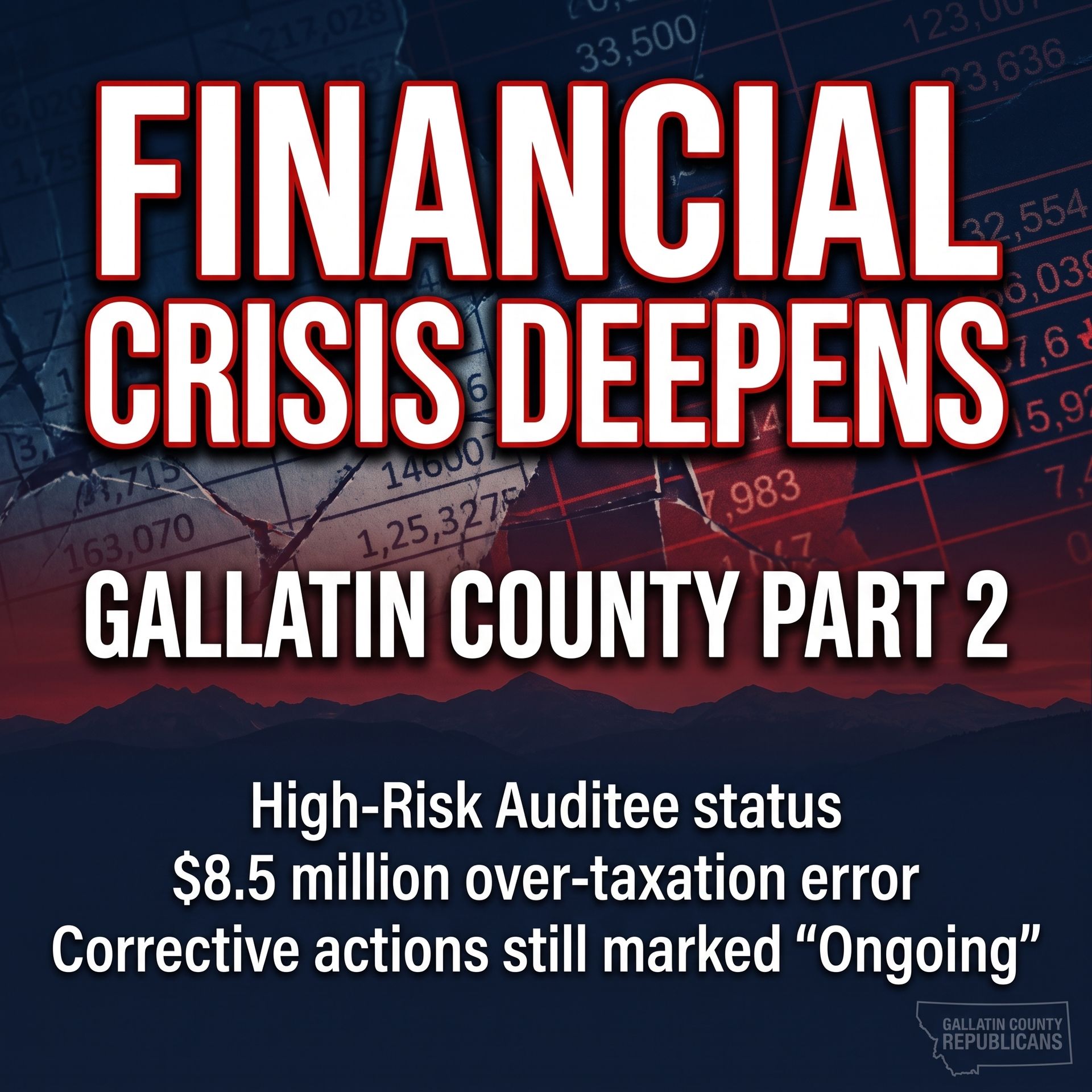
In Part 1 we reported that Gallatin County received a Disclaimer of Opinion on its FY2023 financial statements — the most severe audit outcome possible — and was designated a High-Risk Auditee. That designation is not symbolic. It is reported to the federal government and is visible to every agency that awards grants or funding to the county. It remains in place until the problems are fixed.
The practical risks are real. A sustained High-Risk Auditee status can affect the county’s bond rating and its ability to receive federal and state funds that support infrastructure, transportation, public health, welfare programs, education-related grants, and Payment in Lieu of Taxes (PILT). If those funds are delayed or reduced, the cost falls on local taxpayers.
The previous hired auditor has already stated it will not begin the FY2024 audit until the long-running cash reconciliation problem is resolved. County Administrator Jim Doar has stated that FY24 is likely to produce another Disclaimer of Opinion. Another Disclaimer for FY2024 or FY2025 would signal a systemic failure rather than an isolated event. The county has already paid $14,565 in state fines for late financial filings.
The $8.5 Million Big Sky Error
On September 30, 2025, the same day the $8.5 million over-taxation of the Big Sky Fire District became public, CFO Justine Swanson resigned. For four years the county had collected approximately $8.5 million more than allowed from residents in that district because of an Excel spreadsheet formula error in the mill levy calculation. The result was a roughly $2.3 million cut to the fire district’s annual budget and a $500,000 deficit. No refund to the overcharged taxpayers has been approved.
A Commissioner described the CFO’s departure as “related to a mistake.” The Finance Director position was later eliminated, and Deputy County Administrator Cola Rowley, who has since resigned, was added as an authorized bank signatory the day after Swanson’s resignation.
County Administrator Jim Doar has said the Big Sky over-collection and the multi-year cash reconciliation failure are separate issues. Both, however, share a common root: the county’s continued reliance on uncontrolled spreadsheets for critical financial calculations — a weakness auditors first flagged in writing more than a decade ago.
The Core Accountability Question
The county’s own Accounting Manual, in place since 2015, required monthly cash reconciliations and monthly reporting to the Commission. Auditors noted the failure to follow those procedures year after year from 2018 through 2022. Yet there appears to have been little meaningful consequence to their warning.
When written financial controls are ignored for years, when major errors surface only after the damage is done, and when corrective action plans simply say “Ongoing,” taxpayers are right to ask who is being held accountable.
This is Part 2 in our series on Gallatin County’s financial and governance problems. Part 3 will examine the broader pattern of authority shifting away from elected officials and the consequences for lack of transparency.