Gallatin County Receives Second Disclaimer of Opinion in Five Years
Auditors could not certify the county’s books for FY2023. Every corrective action is listed as “Ongoing.”
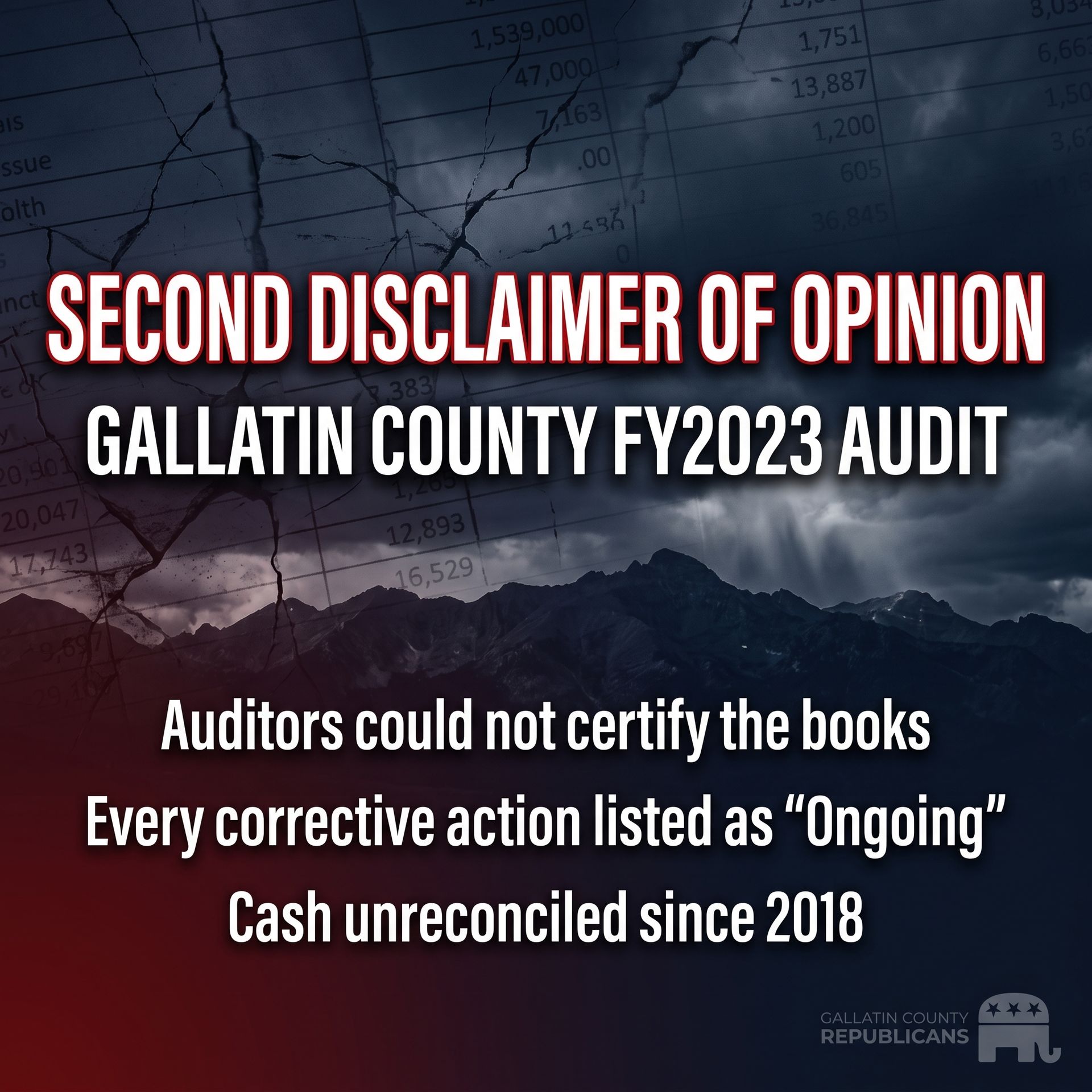
On May 7, 2026, external auditors Eide Bailly LLP issued a Disclaimer of Opinion on Gallatin County’s financial statements for the year ended June 30, 2023. This is the most severe possible audit outcome. It means the auditors could not obtain enough reliable evidence to form any opinion on the county’s financial statements at all.
The auditors stated the core problem clearly:
“The County was unable to reconcile cash and investment balances and could not provide sufficient appropriate audit evidence to support cash and investments as of and for the year ended June 30, 2023.”
Key Findings from the FY2023 Audit
- The county was designated a High-Risk Auditee.
- County finance staff could not prepare their own financial statements. The auditors had to draft them.
- Material weaknesses in internal controls were identified, including ongoing failures to reconcile cash.
- Reports submitted to the federal government for COVID relief funds did not match the county’s own accounting records.
- This is the county’s second Disclaimer of Opinion in five years.
The Corrective Action Plan, signed by new CFO Aaron Mitchell on the same day the audit was issued, lists eight findings. For every single one, the anticipated completion date is simply marked “Ongoing.” No specific deadlines. No milestones.
As of early 2026, the county remained delinquent on Annual Financial Reports for multiple years and on audit reports for FY2023 and FY2024. External auditors have stated they will not begin the FY2024 audit until the cash discrepancy is resolved.
Why This Keeps Happening
The cash reconciliation problem did not begin in 2023. It has been ongoing since fiscal year 2018.
That year the county converted its general ledger software from Tyler’s older Eden system to the newer Munis system. At the same time, a documented decision was made to leave the Treasurer’s tax collection system (TaxWise) disconnected from the new accounting system. Tax collections recorded in one system did not properly post to the other. Written reconciliation procedures were never fully updated for the new software.
The result is straightforward: for eight consecutive fiscal years, the county has struggled to show that what its accounting system says is in the bank actually matches what the bank holds. The gap has fluctuated, triggered crises, consumed consultants, and produced governance friction between elected officials. As of mid-2026, it remains unresolved.
Why It Matters
A Disclaimer of Opinion and High-Risk Auditee status put the county’s bond rating and its ability to receive certain federal funding and grants at risk. More importantly, when a county cannot produce auditable financial statements year after year, taxpayers lose the basic ability to know whether public money is being properly accounted for.
This is Part 1 of a series examining Gallatin County’s financial and governance problems. Future articles will look at how the cash reconciliation crisis began, the role of successive finance leadership, and the broader shift of authority away from elected officials.
Gallatin County residents deserve clear, timely, and accurate financial reporting. Right now, that is not what they are getting.