CI-128 Update

GCRCC • July 22, 2024

Share this article

Fellow Republican Representatives,


As we all know, the Montana courts have consistently taken it upon themselves to do our job as legislators. Once Democrats lost their Governor veto pen backstop, their last resort has been to run to judges to stop sound conservative ideas, and even some important bipartisan reforms, from becoming law. Ideas that the people of Montana voted to send to Helena. There have been many instances where judges have taken over our role as the Legislative Branch to implement their own preferred politics and policies, rather than simply adhere to the constitutional rule of law.


This happened during the preparation of the current petition for CI-128 when the MT supreme court ruled the Legislature should be bypassed and signature gathering allowed to begin without the usual process of a legislative interim committee conducting a vote and giving its opinion to better inform potential signers.


Now, we are on the threshold of being unconstitutionally usurped again. On June 10th, Montanans for Reproductive Rights (Planned Parenthood and ACLU) and the out-of-state big money interests pushing the election initiatives sued SOS to get a ruling on who counts as a "qualified elector."


Article III of the Montana Constitution  requires that only signatures from "qualified electors" qualify for ballot initiatives.  Montana Code Annotated 13-19-313(2) , passed by the Legislature, states that "the election administrator shall place the elector on the inactive list provided for in  13-2-220   until the elector becomes a qualified elector. In order to become a qualified voter, an elector shall follow the procedure in  13-2-222  or  13-2-304 , as applicable" (emphasis added). In other words, inactive voters are clearly, by law, not "qualified electors." This is the Secretary of State's position--that she is following the Constitution and the law as passed by the Legislature.


Of note, the Oregon Supreme Court, a liberal court in a state with similar constitutional provisions to Montana, previously ruled on this issue, finding that inactive voters are not "qualified electors."  You can see that decision here . Also of note, the language about how an inactive voter becomes a qualified elector, referenced earlier in this email, came from SB 498--sponsored by Democrat Sen. Shane Morigeau--in the 2023 session. Democrats contributed to that statutory language just a year ago; now their allies don't want to abide by it.


There are policy differences among legislators, including among Republicans. However, when we have a constitutional idea that passes both chambers and is signed into law we must have the Judicial Branch, Executive Branch and all statewide offices follow the law. Failure to do so undermines the Legislative Branch as an institution and the rule of law.


We as a Legislature are having our constitutional roles diminished by politically-motivated Montana judges. Please take time to post on social media, write an LTE, and talk to any and all groups to set straight the role of our three branches of government. A good start would be to inform your local central committee of the situation.


Also, if you would like more information on the details of the history of these ballot initiatives and where we sit today please reach out to. Both the SOS and Graybill’s arguments are attached to this email. This court case is going to be intense and fast with signature verification deadlines rapidly approaching. The case potentially has multigenerational implications for our state--both when it comes to the Legislature's role as branch of government, and whether our Constitution will contain new, radically different provisions than it has for the past 50 years.


We hope you all are enjoying the sunny MT summer.


Matt Regier, Speaker

Sue Vinton, Majority Leader

Rhonda Knudsen, Pro Tem

Recent Posts

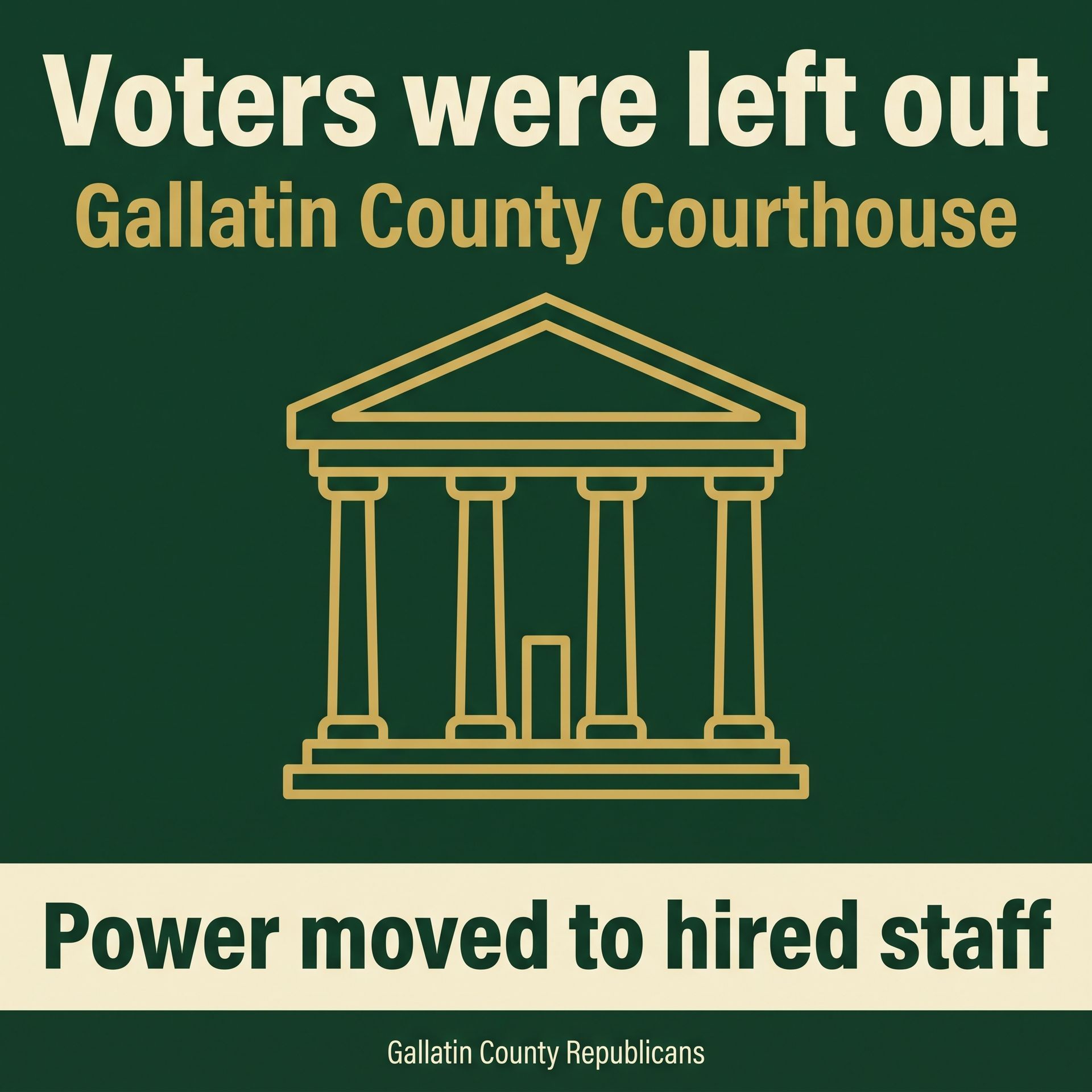
Green political poster about Gallatin County Courthouse: “Voters were left out” and “Power moved to hired staff.”
October 12, 2026
Gallatin County commissioners moved power from elected officials to hired staff by resolution. Voters never approved the change.

Sweet deal for Scott MacFarlane? Facilities job opened three days later.
October 9, 2026
Scott MacFarlane left the Gallatin County Commission Feb 17, 2026. Three days later the county posted the Facilities Director job at $112K–$129K. He got it
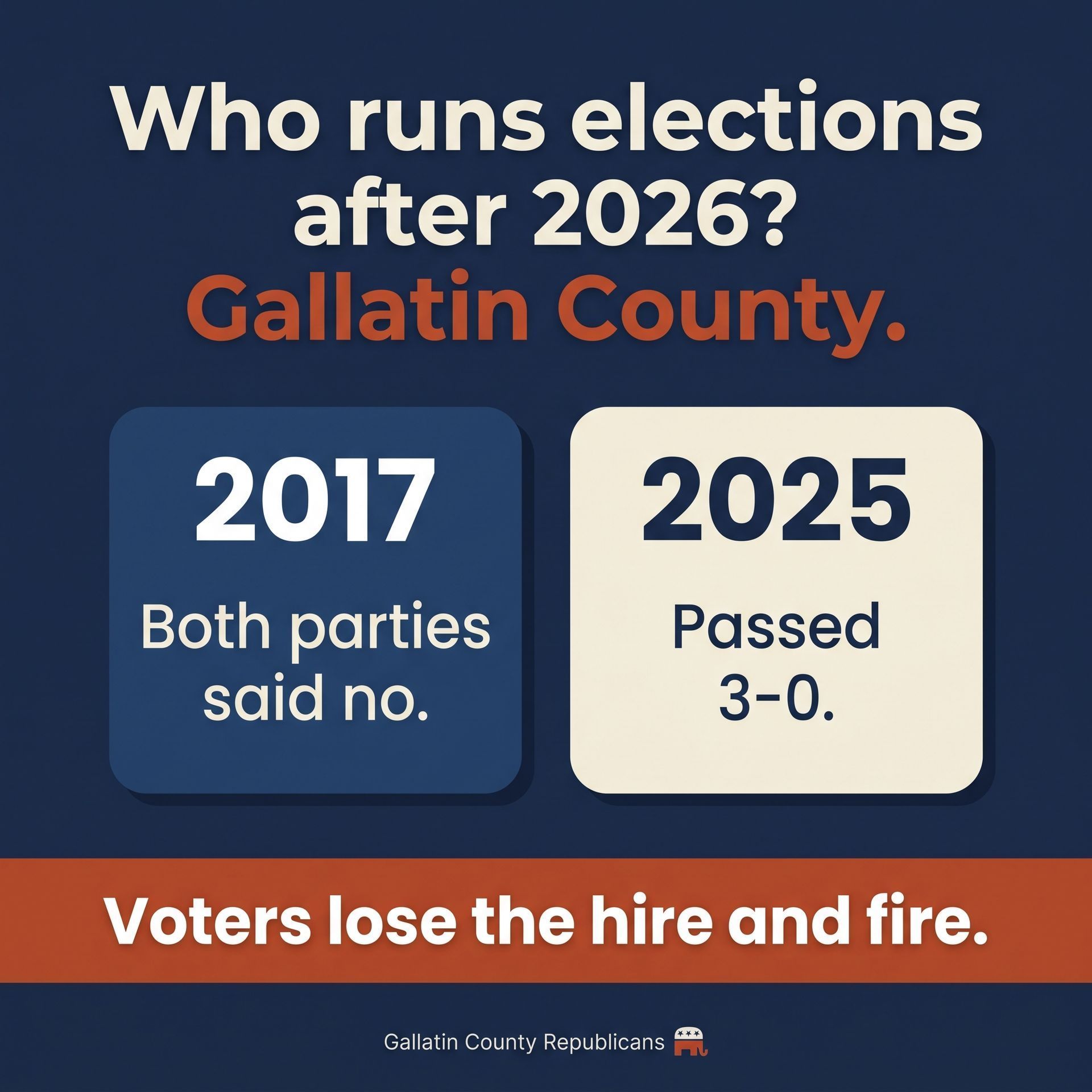
Who runs Gallatin County elections after 2026?
October 8, 2026
Gallatin County voted 3-0 to take the Election Administrator off the ballot in 2027. Voters will no longer directly hire or fire the person who runs elections.
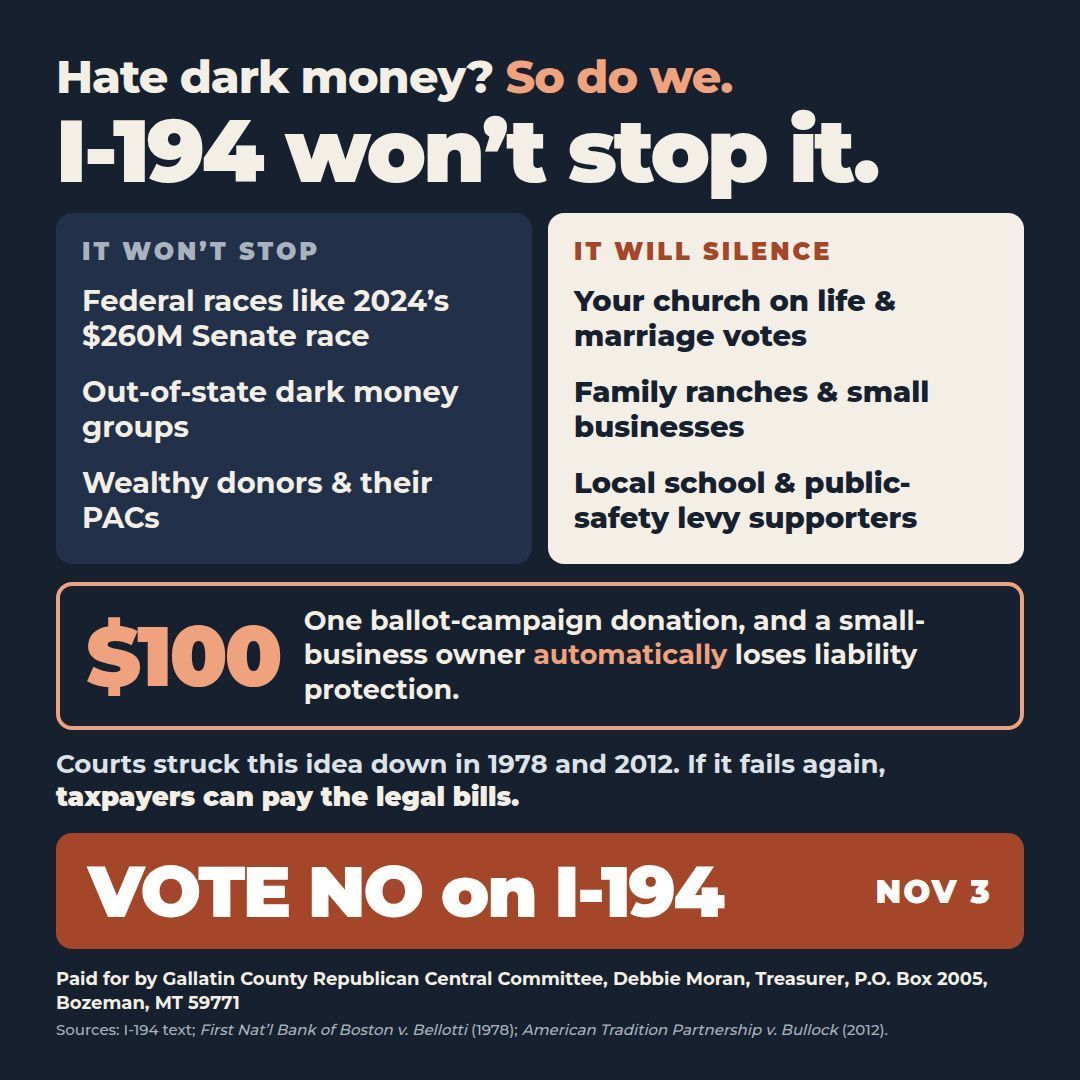
I-194 won’t stop dark money, vote no
By Roger Koopman • October 1, 2026
Explore how I-194 misleads voters while benefiting out-of-state billionaires. Stay informed on local political rights.

Stylized U.S. Capitol with red and blue paint splashes
September 22, 2026
Montana, Kalispell, and Billings chambers urge a No on I-194: it would silence local businesses while out-of-state billionaires could still spend freely.

Brass scales of justice and a lamp on a desk, with a blurred lawyer writing in the background
September 22, 2026
Most Gallatin County police and sheriffs’ offices have endorsed Jordan Salo for County Attorney. Here’s why they say they won’t back Audrey Cromwell.

Oppose I-133: Don't weaken Montana's Constitution
September 14, 2026
CI-133 Seeks to make placing ballot initiatives on the MT ballot an easier process, therefore circumventing the elected legislature.
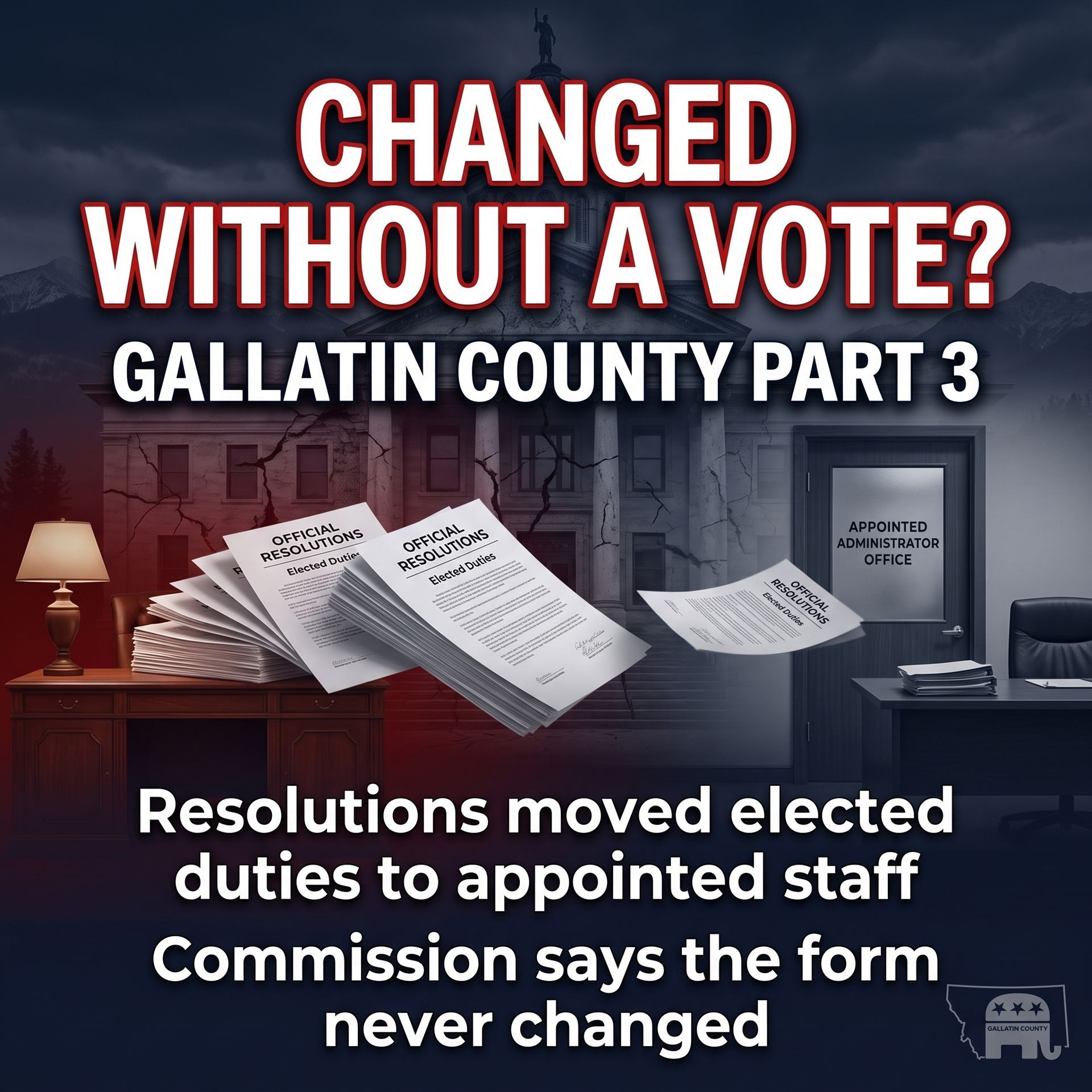
Was Gallatin County’s form of government changed without a vote?
September 3, 2026
Part 3: Gallatin County used resolutions to move Treasurer, Administrator, and election duties away from elected officials. The Commission says the form never changed because voters never approved a new label.

Meta logo beside a smartphone facial scan icon and ID card on a dark background
August 31, 2026
Meta’s $17B deal isn’t teen limits. The judgment makes adults surrender privacy, ramps up surveillance and account linking—and Meta waived constitutional challenges.
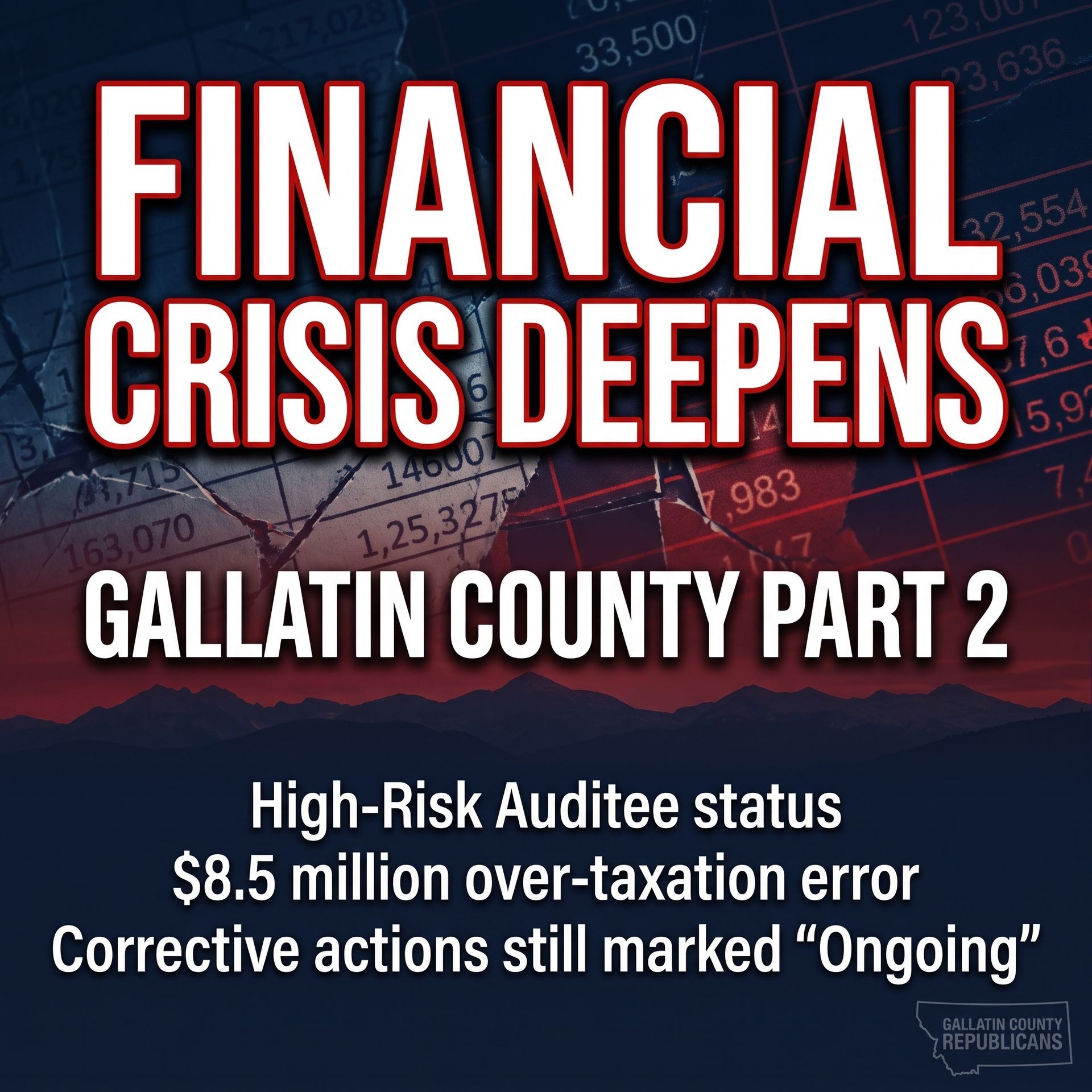
Gallatin County financial crisis deepens with High-Risk Auditee status
August 21, 2026
Gallatin County faces a deepening financial crisis with $8.5M over-taxation issues. Stay informed on local governance and accountability.
Show More